
Terfing Amsterdam
On the eve of World Pride Celebrations, I meet with local sex realists

In April of this year, I was planning a European vacation with a college friend who now lives in Italy, where she has been attending the Florence Academy of Art. We spoke of all the places we wanted to travel, from Budapest to Scotland.
As it happened, I had recently been contacted by two sex realists, both based in Amsterdam, but didn’t know each other. Both had been prompted to contact me because I had confronted Judith Butler. One wanted to know how I came to do such a feat. The other told me Butler’s response to me had so enraged her that it accelerated her plans to go public about the impact of trans ideology on women. Butler’s words had stripped her of any remaining reservations.
That two sex-realists were contacting me from the same part of the world about an event that happened nearly two years ago seemed too serendipitous to ignore. So I thought, why not go there and look them up? By the end of April, I had my ticket booked, and my friend agreed to meet me there. Just as we finished planning our entire itinerary and booked all the tickets, my friend discovered that the rules for her student visa had changed and she couldn’t leave Italy until her renewal card was in her hand. I decided to go anyway even though I had never traveled alone to a foreign, non-English speaking country. I never did that gap year backpacking thing that my more intrepid peers did back in the day. So maybe it was time.
I thought I would be taking a vacation from my punishing writing schedule, as an embedded TERF journalist, but instead I discovered my travel writing side as I regaled my friends with my adventures seeking out restorations of preindustrial living spaces from windmills to Rembrandt’s house to a Cold War-era nuclear bunker built by the Communist Party in Prague.
The one sex-realist post I was obliged to write, when I brought my new friends together, gave me the opportunity to put all my grievances about the trans occupation, especially the egregious progressive flag and gender neutral toilet signs.
But this would not be my only take on Amsterdam, in the hosting of World Pride, as I will report in my next post.


My mission for Amsterdam would not be complete without a sex realist report.
Five sex realists traveling, from all over the Amsterdam area, convened for lunch, on a Sunday afternoon, at the Stedelijk museum outdoor cafe to be introduced. Tables there were spaced ten feet apart so we would talk freely without disturbing others with our raucous heretical chatter.
This being the week before World Pride Week, Amsterdam had decked itself out in progressive flags on various buildings and banner style across some streets.
I have retrieved, from my photo archive, a photo of a trick we sex realist have done with that badly designed, ever changing LGBTQ alphabet-mafia flag. (The Rainbow Flag was plenty inclusive enough, but with every regime change there must be a new flag to mark territory having been taken.
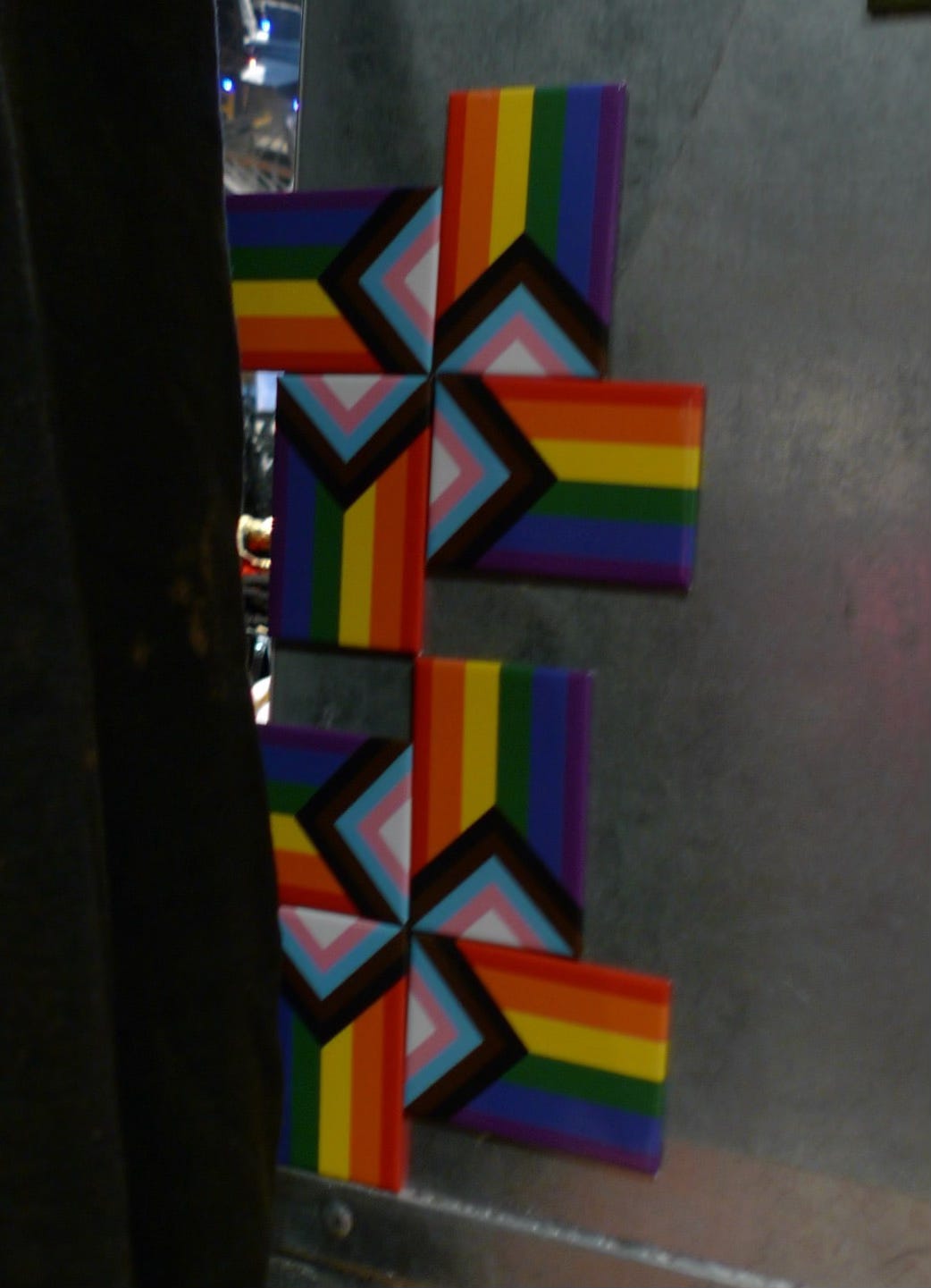
The photo was from my trip to Provincetown, with Ellie and her wife, back in 2023. There I found some refrigerator magnets of said flag and by arranging them corner to corner a Swastika appears, thus displaying our opinion of what this flag represents with the No Debate demand and the self I.D laws that gave men the right to invade women’s spaces with impunity, and with gender non-conforming children being taught that they have the option to change sex because they might have been born in the wrong body.
There is also the matter of the confusing nature of the gender neutral bathroom signage. A mom of a seven year old recently related that her child did not go to the bathroom for five hours, on his first day of school, because he could not figure out who the gender neutral sign was for.
My example, of said signage is from the Anne Frank museum, and is common in new buildings in Amsterdam. I imagined talking to Anne about these renegade ideas, how they creep in innocuously enough, with symbols and flags, then are everywhere intruding into so many shared aspects of public life. While we are not to talk about it in liberal circles.



But talk we did for three hours. It was my pleasure to introduce Bev Jackson, the founder of LGB Alliance in the UK, to Heli St. Luce, a UK born poet, who recently gave a presentation, at our WoLF camp, about the Nordic model of legal prostitution.
Their delight at meeting each other was clear in their animated conversational style, speaking bluntly, interrupting each other with questions, and both talking at the same time. Not the usual manner of the English, at all, which is likely why they left England.
Also present were two other writers, prominent in their fields, who will remain anonymous for the time being.
I did not need to say anything at all except to regale the group with my story of having stood up to Judith Butler, which was the reason Bev had contacted me in the first place, to get the story from the source as it were.
Even if nothing more comes of this meeting it was a success in its own right for having brought together women, in enemy territory who felt isolated before.
My use of occupation language and mention of Anne Frank reflected my earlier visit to her Secret Annex hide-out. I include this related post of my visit to the Anne Frank museum as it says something about how I became the writer I am. How she imparted her observational powers and truth seeking perspective to me at so young an age.


My first stop in Amsterdam, and I mean straight from the train station upon my arrival, was to visit the Anne Frank House museum, for which I had a timed entry ticket for 10:30 a.m.. courtesy of my new friend, I hadn’t met yet, so I didn’t have to wake up at 2 a.m. to book because tickets go so quickly.
I was still in my traveling clothes. In fact, I had slept in them, having missed my connecting flight, which would have had me arriving the night before. I was able to rebook a 6:30 a.m. flight and sleep in the airport at Heathrow. Shouldn’t every traveler sleep in an airport at least once? Hah. No.
But that was the spirit in which I took it, and I shared a bench with another traveler who had done the same thing. My arrival at 8:30 a.m. gave me two hours to get my train ticket, find the right platform for the City Centre, find the Left Luggage place, make sure I had Wi-Fi, and ask for help. Which I did at least 5 times because I had never used my phone’s map ap to go anywhere before, being the analog map reader girl that I am.
People were happy to help, having not seen such an anachronistic traveler holding a tiny accordion-fold tourist map and asking for directions in some time, so much do we look to our phones now. I was glad to see the map had Anne Frank’s house illustrated on it, which told me how important my quest was in relation to this city. Just like the Colosseum is on the map for Rome. So it was with a sense of a miraculous act of faith that I had persevered and made it exactly in time to get in line with all the other pilgrims who were mostly Dutch and didn’t speak English.
At which point I remembered why Anne Frank had been such an important literary figure in my life. More even than I had realized. And not just because of her story. Her story was just the fact of her life during a monumentally tragic time in history.
It was much more personal than that. When I found Anne’s book in the school library, I was the same age as she was when she started the diary, so I felt an immediate simpatico and that I had found a friend. I was already keeping a diary, had done so from the time I was eight. At fourteen, I had abandoned the key-lock daily diary for a tiny notebook I called Notes On Life in an attempt to expand my mission as a writer (while simultaneously limiting expectations).
I was pleased that someone my age had also taken this on, but what she had done with it was far more than I had imagined. She introduced to me the idea that one’s feelings could be expressed in writing. This is not an easy concept for a child of the East, and the British weren’t all that much help in this department either. Stiff upper lip and all that.
Even more significant than I could have realized at the time was that she wrote the diary to an imaginary friend to whom she could confide everything. She had an audience in mind who was not going to judge her. It was the literary notion that someone cared and loved you unconditionally that, in turn, was a form of self love. She was also an optimist. One who imbued her sense of the future with hope that had not been erased even with all that was going on. She saw the Nazi regime as an aberration and had compassion for the goodness of the rest of mankind. Those feelings set a template for me of how to proceed in this Western world. I read her diary again when I was 16, which was when the Nazis got her. This second reading allowed me to see how much both Anne and I had matured. That with age would come more wisdom and reflection. More desires and a philosophy of life.
The museum requires that you walk through it with the audio tour. This is a way to insure that everyone moves at the same pace, proceeding through the account of the Nazi persecution with bits of documentary films; how this persecution affected Anne’s family and then onto the logistics of the building and how the Secret Annex was created behind a bookshelf. By the time you actually enter through that very bookshelf, you are living the story. I was fascinated by the space, the tiny-ness of it. The actual walls decorated with photos from newspapers and magazines.
There is no furniture, so the bathroom was more visceral with its decorated toilet and sink. Anne never described the toilet and must have taken for granted that it was decorated in the same blue and white as the Dutch did their crockery. That did give me a laugh. It was behind plexiglass, so I wasn’t able to look at the decorations. The kitchen counter was also original, so we were not allowed to touch it or the rusted drain. But the sink was there with no such prohibition. I approached it and placed both my hands on either side of its square porcelain body, feeling myself touching that which Anne had touched and the life she had lived. There was a mirror above the sink; I looked at myself in it and connected with her in that life.
Not one I, of course, wanted to have any part of, but it did remind me that I too had had to leave my own happy life that I thought was normal, when my parents saw fit to immigrate to the U.S. I realized, after I had toured Anne’s house, how alone I was in that endeavor. Anne helped me with that, helped me see how to make the best of it by keeping your own self intact. By telling the truth about your feelings and what you observed. Plus there was the scene where she relates how she and a friend had touched each other’s breasts. The scene that enlisted every homosexual reader of her diary into her story. The persecution story of her time and ours.
The diaries, too, were there. How tiny and finely drawn her handwriting was with no crossings out. (Even Dickens had crossed out words I remembered from having seen his original manuscript at the British Museum.) It takes presence and care to write like that.
I believe that keeping a diary was likely the key to us both maintaining our mental health. The museum also replicated the school created for Jewish children who were no longer permitted to attend school, and there, too, the point was to maintain cultural normalcy. (To maintain a meaningful culture at all would help as Gandhi implied.)
I exited through the gift shop, looking at everything, and buying a few visual momentos of Anne and the room she shared with her sister, talking to the cashier, a gay man who listened to me tell him how Anne had helped me when I was the same age. “Oh, you’re family,” he said as much to himself as to me. He asked where I was from and told me there was going to be a tour and it was going to be big, appearing in all the major cities, San Francisco included, so I should look out for it. “Really?”, I said in that drawn-out British way of acknowledgment that I used to say as a kid.


How brave of you to travel to Amsterdam solo. And how great is was for you to meet Bev & other sex realists there. Thank you for this travelogue to my home country (residing in Australia now) . Looking forward to the next part of this visit.